
The school year begins
Three questions about the purpose of public education.
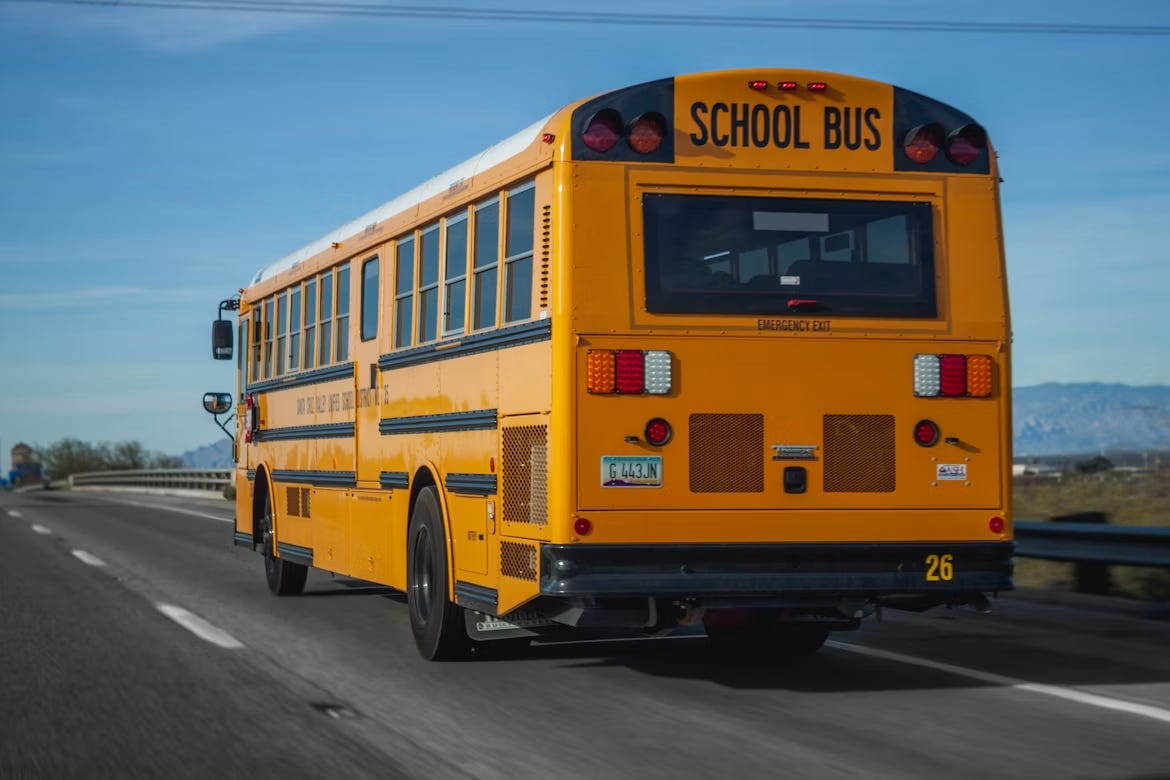
Arizona is going to have a new Superintendent of Public Instruction next year.
Tom Horne, the incumbent, lost to Kimberly Yee in the Republican primary. Yee is currently the Arizona State Treasurer.
The Democratic candidate will be Teresa Leyba Ruiz, a career educator who used to be the president of Glendale Community College.
The job of the Superintendent is administrative in nature, but whoever wins the office becomes the de facto spokesperson for education issues in the state.
Last month, the Arizona Agenda interviewed the Democratic candidates running for Superintendent. (The Republicans apparently didn’t respond to a request to be interviewed.)
The interview questions were great, and I want to share my thoughts on three of those questions here.
1. What is the point of public schools?
Democrats tend to see the function of public schools more broadly than Republicans do. The candidate who ended up losing the Democratic primary told the Agenda that public schools are “the lifelines and bloodlines of our communities.”
Teresa Leyba Ruiz gave a more practical answer:
The point of public schools is, well, public education. Education is economic development. Education is a public good — we all benefit. Lots of research shows that educated communities are safer, healthier, more productive. (Public education is) a foundation of our democracy.
In my view, the primary purpose of public schooling in the United States is to form citizens capable of maintaining the republic. This means prioritizing history and civics, which we definitely have not been doing in recent decades.
Because public schools are operated by the individual states, there are other goals involved, and I think Ruiz’s answer captures these goals in a nutshell.
Some people argue that public schooling should remain strictly academic in nature. Teach history, teach literature, teach math and science, and allow learning and knowledge to be an end in itself. Economic development is tangential. Industries can train their own workforce if they need to.
More common, though, is the view that schools should train students to compete in the economy. This becomes a justification for a certain style of education. You can teach literature just fine with regular old books, for example, but if your goal is to prepare students for the jobs of the future, you might need classes in how to use artificial intelligence.
When talking about public schools in Arizona, an additional question needs to be asked:
What is a public school?
Arizona is a school choice state. We have traditional district schools, we have charter schools, and we have empowerment scholarship accounts (ESAs) that allow private school students to access public money to pay tuition.
Charter schools are operated privately, but they rely on state funding. They adhere to the state’s academic standards, they administer state tests, and they are tuition-free for students. Charter school teachers need certain qualifications but don’t need a teaching certification. Charter schools can opt to participate in the state’s retirement system. I consider charter schools to be public schools, but not everyone puts them into this category.
Private schools are private schools, and with universal ESAs, each student can get at least $7,000 from the state to pay tuition. Proponents argue this is only fair given that these students would be entitled to an even larger amount of public dollars (which their parents help pay in taxes) if they were to attend a public school. Opponents argue there should be more regulations attached to the ESA money.
I am one of the few people in Arizona without a strong opinion about ESAs. On this blog, I have mostly used the ESA issue to make a point about the flaws and contradictions in our state testing system.
Alas, the ESA debate continues to dominate all other educational topics.
2. What about social-emotional learning?
In the Agenda interview, Teresa Leyba Ruiz said that social-emotional learning is “helping students learn how to understand their emotions, helping students to learn how to regulate.”
Obviously, teaching is a profession that requires people skills. Teachers should encourage students who feel frustrated. Teachers should set behavior expectations and respond to misbehavior with corrections or consequences. Some teachers may incorporate methods to foster mindfulness in class.
But this is different from the idea that “social-emotional learning” or SEL should become an additional set of standards added to the curriculum. Math class does not need to incorporate a mini-curriculum on human psychology, yet this is what SEL proponents are often talking about. There are math textbooks on the market that include SEL lessons.
In her answer about social-emotional learning, Ruiz brought up the culture wars:
All of these culture wars are about distractions, so we don’t have to focus on the real needs of our students. When we’re talking about literacy rates, or their progress in math, that’s not a political issue. Literacy rates don’t have a political party.
One of the reasons why social-emotional learning got caught up in the culture wars is because left-wing ideologues went to work on changing the SEL curriculum in 2020. So it’s not necessarily just about mindfulness, anymore.
In my view, the way to depoliticize the classroom is to go back to the fundamentals. Focus on teaching the subject material. Be empathetic, but refer emotional learning to the psychological professionals.
3. Is there too much technology in schools?
I was a little surprised by the lack of enthusiasm in the Democratic responses to this question. I have speculated before about the possibilities for anti-tech populism. I can imagine a Democratic candidate preaching fire about the damage Big Tech is doing to young people and the need for healthier, screen-free environments.
Teresa Leyba Ruiz answered the question in the style of an objective journalist:
The reality is students are using artificial intelligence all the time. The older they get — I can’t speak to the littles — they’re using AI all the time. Teachers are having to use things like AI detectors for writing assignments. I was talking to a professor (who) said that he’s going back to blue books. He said that if you make an assignment for out of class, who knows what you’re going to get.
There are conversations around how young is too young, some saying that pre-third grade students shouldn’t be on Chromebooks.
The Superintendent of Public Instruction is not in charge of setting tech policy at schools, and it’s probably better for a candidate for this office to avoid demagoguery. Ruiz’s observations, though dispassionate, point to a concern about potential problems with technology.
But Democrats are in need of a fresh vision about what education should look like. They are stuck defending the status quo. They want to add more regulations to school choice and they want more money for traditional public schools. What else?
I think they should go big on civics education and try to gain the high ground on patriotism. But I’m not holding my breath on that.
There is room for one (or both) of the political parties to go on the attack against the “screen-based childhood” that hurts young people but benefits the Big Tech companies. It seems like the culture is shifting in this direction. The movie Toy Story 5, for example, revolves around the premise that real play is healthier than screens.
I would be interested to hear Kimberly Yee and Teresa Leyba Ruiz discuss this topic in more detail.
Unlike the topic of ESAs, their views on tech policy might not be too different from each other.
Thank you, Billy, for taking this one on. It needs our most serious and critical thinking—and action.
You forced me to think about the subject. So I did. I don't apologize for the length of my response; you are the one who started this!
This is incomplete, given my own limitations. However, having benefitted from two excellent school systems—one in North Dakota and the other in California (how distinctively different can you get!) and having been privileged to teach part time at two Universities, I have a sense of the educational terrain.
Our world is complicated, conflict ridden, full of opportunities to be taken or lost, changing rapidly in unprecedented ways, with vastly different family circumstances that impact educational options. It is a more challenging place to live than when I started school during the Great Depression. The traditional basics remain essential, but the number of topics we need to understand at a basic level is necessarily greater than a hundred years ago.
It would be a huge mistake to ignore the core of individual capabilities that have been constant over modern times. They are simply inadequate to equip our students for the world they will inhabit as adults.
Basic premise: Our children are our future. All of them. Each one. If we shortchange them, we also diminish ourselves and our Nation. That is unforgivable. It is also foolish in the extreme.
We need our children to be productive citizens who live rewarding lives. Citizens who contribute to society as well as deriving support from it.
The basic question: How do we equip all of our children to live the most productive and rewarding lives possible with respect for their individual qualities?
Purpose: An adequate education in the context of 21st Century America and global realities needs to provide students with the basic tools needed to prosper in our society and live rewarding lives commensurate with their natural abilities. That includes competence in:
English - communicate effectively in spoken and written form
Math - use numbers competently
Science - understand basic concepts across major disciplines, especially ecology
History - grasp an accurate understanding of U.S. and World history
Social skills - developing the ability to connect effectively with others
Civics - be conversant in the structure of our governance and practices of citizenship
Technology - have a basic grasp of the dominant technologies need to navigate the contemporary world
Life Skills - be competent in basic skills for living in contemporary society: money; budgeting; insurance; ownership options; employment; family support, health
Certainly electives must be available in the arts, foreign language, advanced studies, trade skills, athletics, and other categories that augment a student’s potential in accordance with his or her interests and our collective experience. Options need to be as diverse as local conditions permit. Fortunately, some of these choices that do not demand real time activity can be pursued via alternative sources, such as remote classes.
The proportion of time devoted to each of these subject areas is something each school district must resolve. Some basic topics deserve multiple years of full course work. Others deserve coverage, but not necessarily an entire course. But ignoring a critical topic would be a disservice to the student and to society.
We now have the ability to share best practices broadly, without interference or interpretation by intermediaries. Local responsible authorities can adapt them locally. That is an inherent necessity in light of our exceptional social, economic, cultural, and geographic diversity. As in the natural world itself, diversity is a source of strength and stability, not weakness. That is the brilliance of our National profile and has been so from the beginning.
What our elementary and high school system is not for is solely or even primarily preparation for a four year college. It is preparation for living life. That may or may not entail advanced education. If it does, many forms of it are all legitimate options, depending on what serves the individual’s needs best.
In summary: Become competent in the knowledge base required to prosper in contemporary society, acquire the ability to determine a meaningful direction for further education or entry directly into the workforce, be a responsible citizen, and establish a foundation for living a rewarding life, given each person’s unique capabilities.
In one sentence: Equip each child to live the most productive, satisfying, and rewarding life possible.
Any educational system that arbitrarily imposes limitations on any student for a biased reason is not merely unresponsive to our real needs. It is fundamentally immoral.