
The analog advantage
Reasons to limit the use of screens in the classroom.
There is a certain feeling of inevitability when it comes to screens and artificial intelligence. Technology is expanding so rapidly that people are starting to wonder if there is anything better about the human mind.
In the classroom, however, it simply isn’t true that a tech takeover is inevitable. The whole business of education, after all, is the development of human minds.
Digital tools might work better for certain classroom tasks, but analog tools can work just as well, if not better, for the core mission of education.
The goal of a classroom is for students to gain knowledge, insight, awareness, and intellectual habits within a field of study.
What’s more effective?
Analog: Students listen to a lecture from a real teacher and take notes by hand. Students read from a physical book and answer questions with a pencil and paper.
Digital: Students watch a video of a lecture and then receive an AI-generated summary of the notes. Students read a digitally enhanced textbook and type answers to questions on a Google Doc.
Keep in mind that, for any task that is assigned on a screen, half the students are going to try to use ChatGPT to answer the questions. It is very hard for a school system to provide digital education tools while denying access to digital tools that replace human thinking.
What about a class discussion?
Analog: Students sit in a group with peers and learn to speak their mind while listening to a lively conversation.
Digital: Students participate in a digital forum where everyone types and submits their ideas. Each person’s identity is represented with a digital avatar.
Part of the problem with framing the choice in terms of “effectiveness” is that the metrics we use to measure educational outcomes are so flawed, at least for the humanities. In the United States, in a push to measure reading, we’ve built a counterproductive testing system that, in practice, has created incentives for schools to teach fewer books.
So it might be better, rhetorically, to frame the choice in subjective terms where human minds retain a comparative advantage. In education, words like “inspiration” and “wonder” are real things.
Here’s the point I want to emphasize: We have a choice.
As a society, we have a choice as to whether to allow young people to spend their waking hours scrolling on TikTok, or not.
We have a choice as to how to run our classrooms.
I’m not saying analog is the only way to do things. I know for a fact there are excellent teachers out there who love using digital tools in the classroom. There are students who find success taking classes online. But here is how I teach:
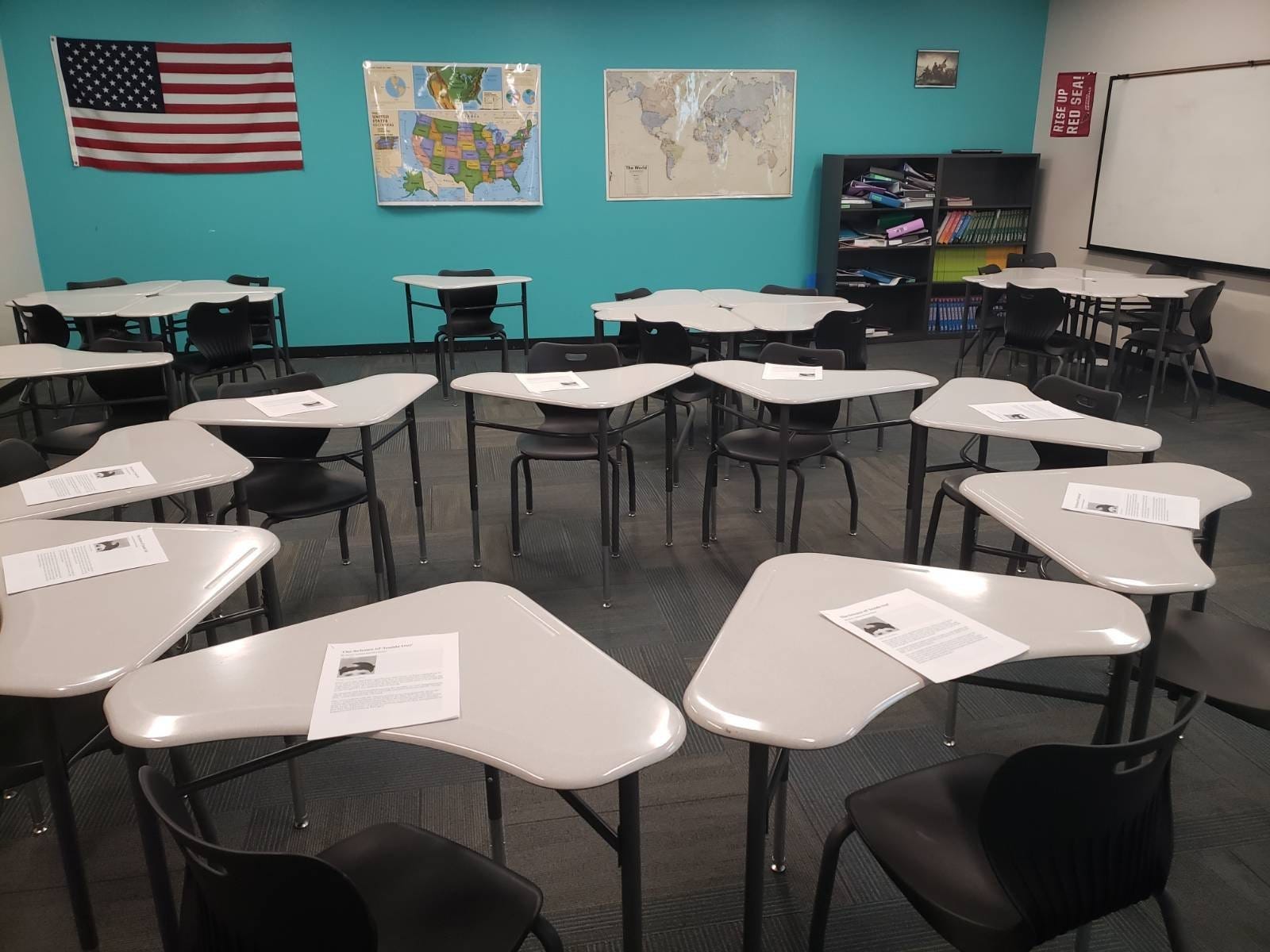
In my classroom, we probably spend 90% of our time on paper and 10% on screens in a typical week. My students have laptops, but we read mostly from physical textbooks or printouts. At times we will look at maps or random things with a computer. At times I will post a PDF online instead of printing it out. I often write notes on a Google Doc projected onto the whiteboard because my handwriting is hard to read. Students take notes on paper, and most of our assessments are on paper.
I am a digital tech skeptic at heart. I’ve kept a blog since the early 2010s, and I enjoy sharing this newsletter with folks online, but I’ve always been wary of how digital tech encroaches on human flourishing. In my first ever blog post in 2011, I wrote about the IBM supercomputer Watson beating Ken Jennings in a game of Jeopardy! Here’s what I wrote about the human advantage:
What happens in the human brain, although mechanical if analyzed piecemeal, transcends the mechanics of its functioning to produce mind, and in a deeper sense to produce soul. Our biological functions allow us to not simply exchange information with each other but to connect and understand each other.
Robots are “smarter” than humans, as measured by a lot of things. But robots have been smarter than humans at Jeopardy! for fifteen years, and yet people still enjoy watching humans compete on the show.
We get to decide what is important to us. If people prefer to watch human-written movies that feature human actors, we get to choose this, even if robots are capable of creating movies that look the same.
Artificial intelligence didn’t end Jeopardy! and it doesn’t have to end movies, or books, or education.
My preference is to keep it classic when teaching the humanities.
I’m grateful that this option still exists, and I hope that it remains an option into the future.
Again,….great blog! I was thinking it is also like physically doing a science lab experiment versus watching one on a screen.
Speaking of the avatar on the online group discussion, was unique timing because I have recently realized, and have gotten frustrated with social media, where it seem like people are too calloused to making snide and negative comments causing offense and it seems to be a game to them.
…..but that topic is for a different blog.
Love ya Billy!!!
I believe your approach to education is a road for many educators to keep sanity and humanity current. I’m incredibly concerned that our current American public education is broken. I see no statistical evidence that overall excellence has exceeded that of 50 years ago. My son was born just before the Charter boom in Arizona but my grandson was caught in the middle. He is an exemplary student who was lost in the shuffle of an under funded public school with limited curriculum for his talents. We had to move him to a private high school in high school which I do not blame on his highly rated public school but because of a Republican legislature who choose to privatize and capitalize education. My grandson now attends a private college in Annapolis, Md. St. Johns College (SJC.edu). As the 3rd oldest college in America it has been described as “contrarian, innovative, intellectually curious, affordable, inquisitive, quirky and without a doubt most rigorous of colleges..” It’s certainly not for everyone but the school reads the classics from Aeschylus, Homer, Socrates, Plato, Darwin and so much more. Education is the silver bullet and we’ve treated it like a rummage sale.